Signal-Based Selling: Why AI Should Own the Signal, Not the Outreach

CCO Managing Partner

Most companies now say they do signal-based selling. What they usually mean is this: a vendor sends a weekly list of accounts that “showed intent”, an AI writes a first line, and a seller sends it before the coffee is cold. Reply rates go up a little. Pipeline quality barely moves. The team feels busy. The target does not.
That is not a signal architecture. That is faster cold outreach with better adjectives.
I saw the pattern first in private banking. Relationship managers had NNA targets. The book was full. The quarter was not. The conversation that moved net new assets rarely arrived on a random Tuesday. Something had changed. A person, a priority, a pain. The useful outreach came close to that change.
Selling data and AI services, I now sit on the other side of the same mechanic. Our sales managers carry a revenue target. Pipeline coverage can look healthy. The quarter still has to close. More activity does not equal more revenue if the activity is pointed at accounts that are not in motion.
Our process on HICO Forge is built around that fact: Awareness, Buying Process, Customer Growth. Marketing creates the public signal. Commercial growth is supposed to act on change, not on a static list. Consulting and customer success produce the richest first-party signals we will ever get. If those notes stay in the project space, we will keep buying someone else’s guess about intent while the number sits in the current book.
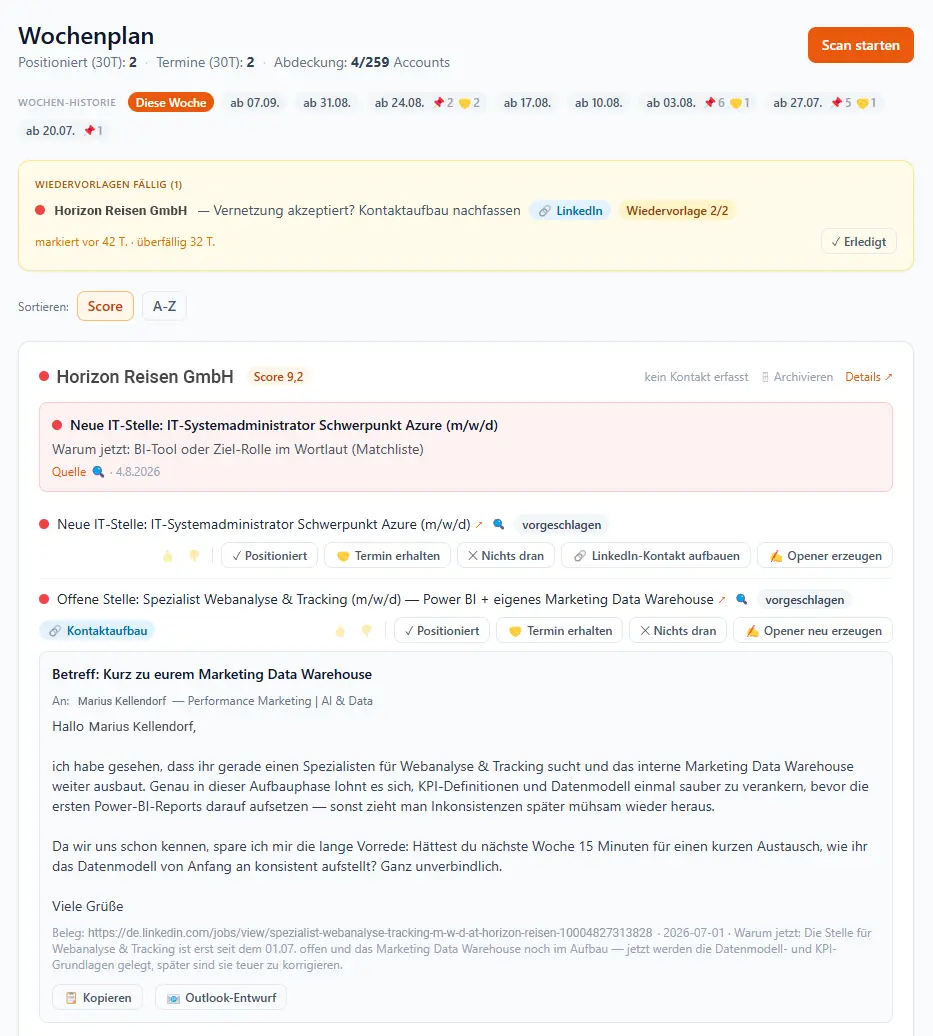
AI belongs in that design. Not as a writer of more emails, but as the layer that notices change, ranks it, prepares the next step and leaves a trace. The person who owns the target still owns the call.
What Is a Sales Signal?
A signal is an observable change that makes this account more likely to need a conversation now. Not “they fit the ICP.” Not “they downloaded a white paper in 2024.” A change. Recent enough that a message sent tomorrow would sound different from a message sent last month.
In practice, these changes usually fall into three groups. First-party signals are behaviour you own: site visits, event attendance, comments on thought leadership, project conversations, NPS and renewal friction. They are often the strongest because they are specific to your relationship with the account.
Second-party signals sit in the comparison layer: review sites, partner referrals and peer mentions. Third-party signals are market events: a new head of data, a funding round, a hiring wave in analytics or a competitor leaving.
The practical rule is simple: do not act on one weak signal. Wait for two or three that point in the same direction. Then move while they are still fresh. First-party signals can go stale in days. Third-party signals often have a slightly longer window.
This is where models earn their place. A person cannot watch hiring, site behaviour, project notes and leadership changes at once. An agent can. The value is not the draft. The value is the stack: which changes arrived together, how fresh they are and whether they justify a human conversation today.
Revenue Targets Do Not Care How Clever the Model Sounds
In private banking, the number on the wall was NNA. Relationship managers were measured on net new assets, not on how many notes they sent. A full book and a missed target could live side by side.
In a data and AI services business, the number is revenue. Our sales managers carry that target the same way.
This is the practical job for AI. It should protect the target by rationing human time. Not by writing more, but by ranking which accounts can still move this quarter.
Concretely:
- Show the seller the account where two or three fresh signals now stack, not the next name on last year’s list.
- Put existing clients with a new use case above strangers with a generic intent surge. Expansion often pays the target faster than cold acquisition.
- Draft the why-now line so the first ten minutes of the call are about the change, not about introducing the firm again.
- Flag accounts that look busy in the CRM and have gone quiet in reality. Those kill quarters.
- Leave an audit trail: why this account was queued, what the seller decided and what happened. Otherwise you cannot learn which signals actually feed revenue.
AI will not carry the NNA target or the revenue target. It can stop the people who do carry it from spending the week on the wrong book.
That is also why the agent must not send on its own. A missed target after 200 automated notes is still a missed target. A smaller queue of conversations built around a real change is how the number moves.
What AI Should Actually Do in Sales
AI is now good at four jobs in this motion. It watches more sources than a person can. It turns a raw event into a short brief. It stacks weak signals into a stronger one. And it drafts a first message that mentions the actual change, while documenting why the account landed in the queue.
It is still weaker at the fifth job: deciding whether this change is worth a seller’s Tuesday.
That is why so many AI SDR programmes disappoint. They automate the send. They do not redesign the decision.
Attaching a copilot to the old process does not fundamentally change the motion. A signal needs to trigger a defined decision: what the model surfaced, what judgment a person must apply, who may decide and what gets reviewed afterwards.
There is a second constraint. Buyers increasingly use generative AI to research vendors and often prefer a digital path for that early research. At the point of commitment, however, they still want a person who can stand behind the recommendation.
So the design is not: “Replace the seller with an agent.” It is: “Let the agent notice, score, draft and document. Let the seller decide, frame value and carry the target.”
The Signal Loop Most Sales Teams Miss
Look at a normal funnel and you will see marketing creating awareness, sales working a lead, delivery running a project and customer success trying to retain. The missed design is the loop.
Delivery and customer success produce some of the best first-party signals in the company. A new use case in an existing account. A pain that was not in the original scope. A stakeholder who just got promoted. If those notes stay in the project space, marketing keeps generating strangers and sales managers keep buying third-party intent.
We built our own motion the other way around. Marketing still creates awareness through the website, events and thought leadership. That is the public signal layer. AI can tell us who came back after a post, who attended an event, who read and did not convert.
Commercial growth does not start from a static list. It starts from signal-based outreach and AI-assisted selection: which accounts changed, how confident the model is and who should speak. The agent prepares the queue. A person takes the conversation.
Consulting is not only delivery. It documents live customer topics and feeds them back into awareness and into quarterly key-account meetings. This is the dataset most intent vendors will never see. An agent that can read project notes and meeting minutes will often know more about the real buying context than an agent that only reads job ads.
After the project, customer success, NPS, deep dives and new-use-case identification sit in the same picture. A need that appears there is a lead, not a footnote. AI should flag the drop in NPS or the second use case the same way it flags a pricing-page visit.
Inside sales holds renewals and commercial administration. Those are signals too. A messy renewal is a relationship event. The model can put it on the same timeline as a new CIO.
What HICO Forge Has to Own
The platform underneath this is HICO Forge. Not because we needed another CRM view, but because the process only works if marketing, commercial growth and consulting see the same account, the same signal and the same owner.
Forge is where citizen development and governance meet. Teams can improve playbooks and scoring. They cannot invent a second definition of “lead” or a private model that nobody else can audit.
That is the same ownership-of-meaning problem we keep writing about in finance and banking, now applied to revenue.
Five objects are enough to start:
- Account
- Signal: type, source, timestamp, confidence
- Suggested action
- Owner
- Outcome: meeting, POC, expansion, no action, too late
Then four rules for the AI layer. The agent watches and ranks. It does not send. First-party project signals outrank a lonely third-party surge. Every queued item carries the why: which signals, how fresh, why now.
And the loop gets closed every week. If champion job changes never become projects, stop feeding that signal to the model as if it were gold.
Without those rules, the system will generate activity and hide the fact that the wrong signals are winning. With them, AI becomes infrastructure for the target, not a content factory.
The Real Advantage Is Not the Intent Data Vendor
The market will keep selling 6sense, Clay, ZoomInfo and the next agentic SDR. Some of that is useful, especially for third-party coverage.
But for a firm that already sits inside the client’s data and AI work, the scarce asset is different. You already hear the sentence that means they need the next project. Most competitors never will.
If you let an agent capture that sentence, stack it with a public signal and give both to the person who owns the revenue target, you are doing signal-based selling.
If you only buy a list of companies that researched “analytics” last month and ask a model to write the opener, you are renting someone else’s guess and adding a nicer paragraph.
Private bankers missed NNA when they worked the list instead of the change. Sales managers miss revenue the same way.
Stop buying intent as a substitute for attention. Own the signals you can actually see. Let AI notice, score, draft and document. Keep people on the decision, and on the number.
If you want to look at how a signal-based sales motion could work in your own organisation, book a 30-minute exploration call with us. We can look at the signals you already own, where they currently disappear between teams and how AI could help turn them into a more focused commercial process.